
AODD Pump Material Selection Guide
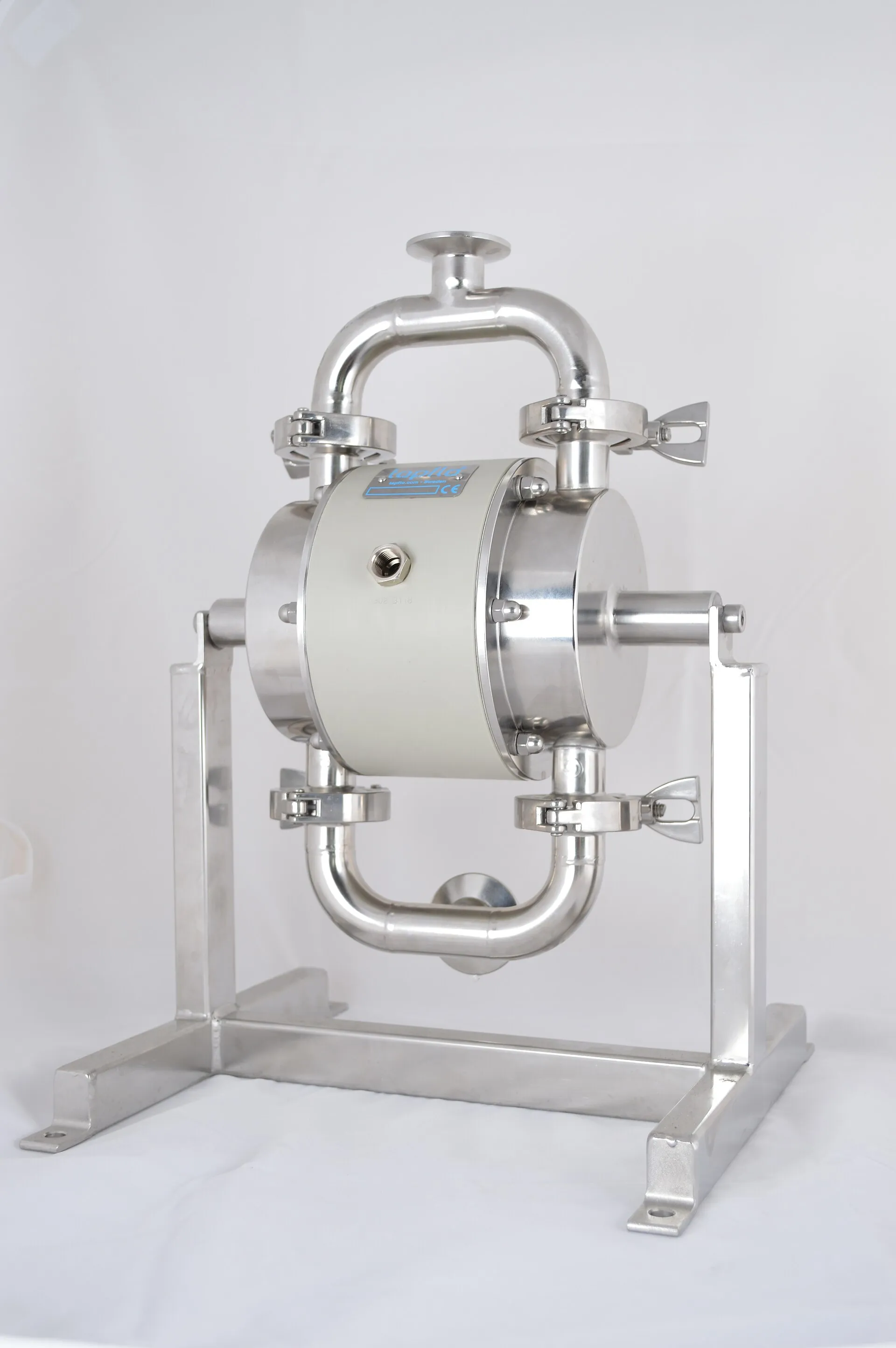
Table of Contents
The wetted-path material is the single most important decision in buying an AODD pump. Get it right, and the pump runs for years on diaphragm kits that cost $16-60. Get it wrong, and you are replacing components within weeks — while an unplanned line shutdown costs hundreds to thousands of dollars per hour. This guide covers the five standard body materials, the five diaphragm elastomers, the compatibility logic engineers actually use, and a quick-reference table you can hand to a buyer tomorrow.
Why Material Selection Matters More Than Anything Else
An AODD pump is a simple machine: two diaphragms, four check valves, an air valve and a body. That simplicity means every wetted component is directly exposed to your fluid. Unlike a centrifugal pump, where the mechanical seal often fails first, an AODD pump's lifetime is determined almost entirely by whether the wetted materials survive your media. There is no impeller coating, no seal flush plan — just the raw material against the chemical.
Material failure in an AODD pump shows up in four predictable ways, and each points to a different fix:
- Chemical attack — swelling, softening or cracking of elastomers and plastics. A Santoprene diaphragm exposed to toluene swells visibly within hours and fails within days. The fix is an elastomer change, not a pump change.
- Permeation — small solvent molecules migrate through the PTFE layer, causing blistering and delamination between diaphragm plies. This is the classic failure in halogen service (chlorine, bromine) and it demands a one-piece PTFE diaphragm rather than an overlay design.
- Abrasion — hard particles erode valve seats and the diaphragm surface. Ceramic slip and foundry sand cut through PTFE valve balls quickly; the fix is stainless or harder ball material plus a slower pump cycle.
- Temperature degradation — every material has a maximum continuous service temperature. Polypropylene softens around 90°C; a steam-cleaned pump run hot without cooldown will creep at the flange and leak.
Choosing the right material up front costs nothing extra. Replacing a diaphragm that failed after three weeks costs you the part, the freight, the labour — and the production you lost while the pump sat idle. The sections below walk through the five standard body materials, when to use each, and the elastomer pairing logic that determines real-world service life.
The Five Standard AODD Pump Materials
Nearly every AODD pump on the market is built from one of five body materials. The table below is the 30-second summary; the sections that follow go deeper on each.
| Material | Relative Cost | Max Continuous Temp | Density | Best For | Avoid |
|---|---|---|---|---|---|
| Polypropylene (PP) | $ (lowest) | 90°C | 0.91 g/cm³ | Acids, alkalis, salt solutions, water treatment | Strong oxidizers, aromatic & chlorinated solvents, hot concentrated caustic |
| PVDF (Kynar) | $$$ | 120°C | 1.78 g/cm³ | Solvents, halogens, strong oxidizers, plating & semiconductor chemicals | Hot concentrated caustic, hot amines |
| PTFE (Teflon) | $$$$ | 120°C (pump body) | 2.20 g/cm³ | 98% H₂SO₄, aqua regia, worst-case corrosion | Molten alkali metals (not a real process condition) |
| Stainless Steel 316 | $$$ | 120°C+ | 8.0 g/cm³ | Food, pharma, sanitary, mild chemicals, high mechanical duty | Chlorides (pitting), strong reducing acids |
| Aluminium | $$ | 90°C | 2.7 g/cm³ | Paints, oils, coolants, diesel, general transfer | Acids, alkalis, salt water |
One clarification on temperature: PTFE resin itself is rated far higher (continuous use to 260°C), but in an AODD pump the body limit is set by the surrounding structure, the fasteners and the diaphragm — so the practical ceiling for a PTFE-bodied pump is around 120°C. Always check the pump datasheet's stated maximum, not the resin datasheet.
1. Polypropylene (PP) — The Value Workhorse
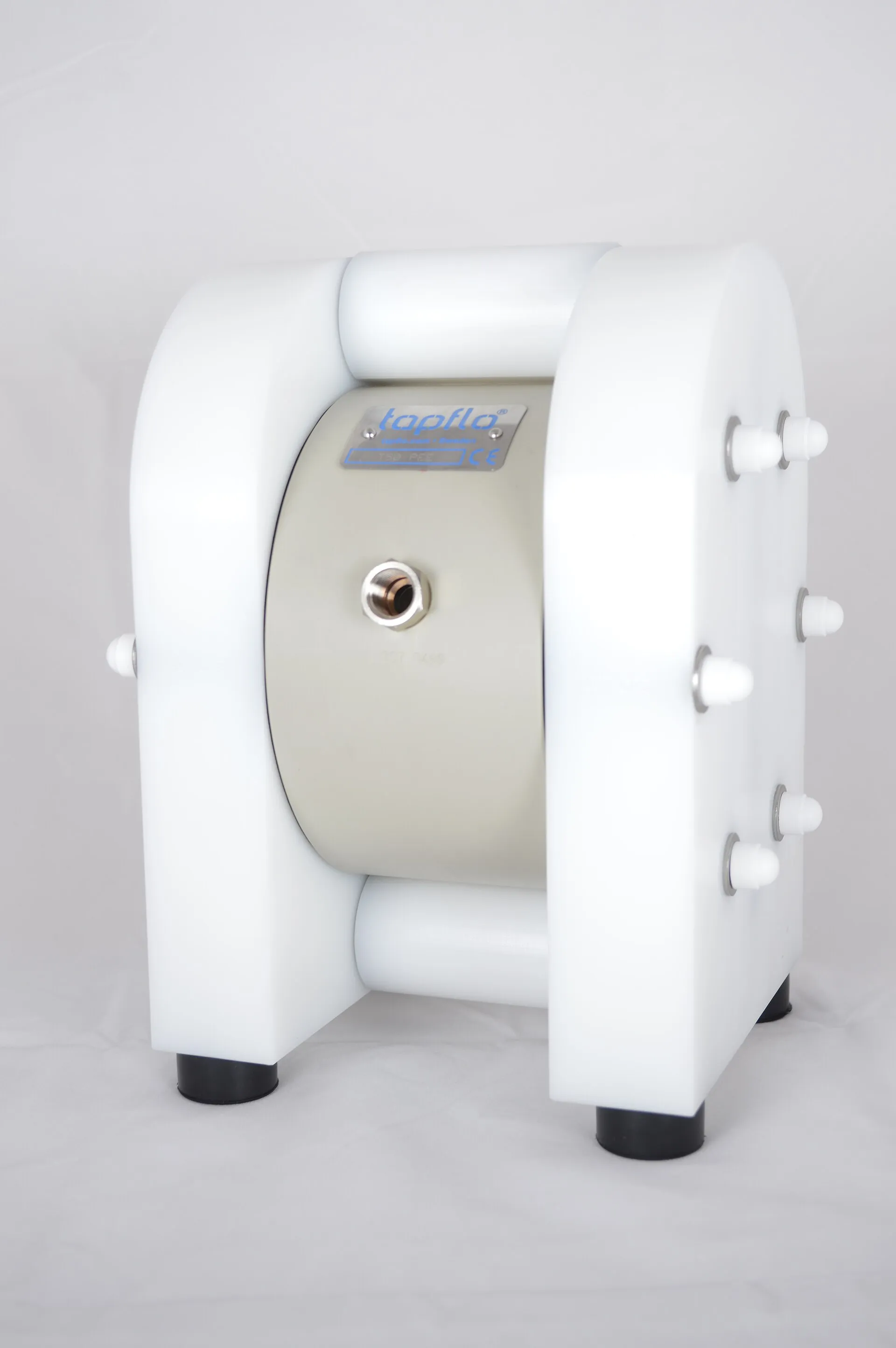
Polypropylene is the default choice for general chemical transfer. It resists most mineral acids at moderate concentrations (sulfuric up to roughly 60-80% at ambient, hydrochloric, phosphoric), alkalis, and salt solutions. It is inexpensive, lightweight and easy to mould — which is why PP pumps dominate water treatment, plating rinse lines and general chemical service.
PP limits: it is attacked by strong oxidizers (concentrated nitric, chromic acid), aromatic and chlorinated solvents (toluene, xylene, perchloroethylene), and hot caustic at high concentration. It also has the lowest temperature ceiling of the plastics — about 90°C continuous. Above that, the polymer softens and the moulded flange will creep under bolt load.
Choose PP when: your media is a mineral acid, alkali or salt solution below 90°C, and first cost matters. That covers a huge share of real-world chemical transfer. A PP-bodied pump with a PTFE diaphragm is the single most common chemical-service configuration in the industry — cheap body, resistant elastomer.
2. PVDF (Kynar) — The Solvent Fighter
Polyvinylidene fluoride steps up where PP fails: it resists most organic solvents, halogens, strong oxidizers and UV. It is the standard choice for plating solutions (chrome, nickel, copper baths), semiconductor chemicals and solvent handling. Its density (1.78 g/cm³) and mechanical strength also make it the stiffest of the three thermoplastics, which helps with vacuum service.
PVDF limits: it degrades in hot concentrated caustic and some hot amines — an unusual inversion that catches buyers out (see the media-groups section below). It is also roughly 5-10× the price of PP by weight, so the premium is real.
Choose PVDF when: you are pumping solvents, halogenated fluids, or strong oxidizers that would destroy PP — and the fluid temperature stays under ~120°C.
3. PTFE (Teflon) — Maximum Chemical Resistance
PTFE is nearly inert: it survives 98% sulfuric acid, nitric acid, aqua regia, virtually every solvent, and most process chemicals. When the pump specification says "worst-case corrosion," PTFE is the answer. It is the material of last resort for chemical processors and the default for the most aggressive duties.
The permeation caveat: PTFE is permeable to small solvent and halogen molecules. Chlorine, bromine and light solvents migrate through the diaphragm ply over time. In halogen service, use a one-piece PTFE diaphragm (not an overlay design that sandwiches PTFE over an elastomer) to prevent blistering and delamination between layers. Overlay diaphragms are cheaper and more flexible; one-piece designs trade flexibility for permeation resistance.
Choose PTFE when: your media is an aggressive acid, solvent, or halogen that destroys everything else — and your downtime cost justifies the premium. For benign media, buying PTFE is overspending; the material wins on chemistry, not on lifespan.
4. Stainless Steel 316 — Sanitary and Hygienic Service
SS316 brings strength, temperature capability and a hygienic surface. It is the standard for food, beverage, dairy, pharmaceutical and cosmetic transfer — especially where CIP (clean-in-place), SIP and FDA compliance matter. Surface finish down to Ra ≤ 0.8 µm is achievable, and the metal body handles the thermal and mechanical stress of repeated hot cleaning cycles that would fatigue plastic flanges.
SS316 limits: chlorides cause pitting and stress corrosion cracking — seawater, brine and some bleach solutions are problem media. Strong reducing acids (hydrochloric at concentration) also attack it. For those, go plastic or PTFE. Note also the weight: a 316 pump is roughly 3× the weight of an equivalent PP unit, which matters for portable or panel-mounted duty.
Choose SS316 when: you need sanitary certification, elevated temperature, or mechanical robustness — or your product is food/pharma grade. A common pairing is a 316 body with FDA-listed Santoprene or EPDM diaphragms.
5. Aluminium — Lightweight Economy
Aluminium bodies offer the best cost-to-performance for benign media: paints, oils, coolants, diesel, general water and sludge transfer. They are light (easy to move around a plant, easy to mount) and inexpensive. For a transfer duty that is chemically neutral, an aluminium pump is often the fastest payback purchase in the plant.
Aluminium limits: no acid or alkali tolerance, no salt water, no strong solvents long-term. It is a mechanical-material choice, not a chemical-resistance choice. If there is any chance the media is acidic or saline, step up to PP or 316.
Diaphragm Materials: The Part That Actually Wears
The body material defines chemical resistance, but the diaphragm is the wear component — and it comes in its own material options. Rule of thumb: match the diaphragm to the chemical, not to the body. A PP body with a Viton diaphragm handles fuel fine. A PTFE body with a Neoprene diaphragm wastes the body's resistance.
| Diaphragm Material | Best For | Typical Life in Service | Primary Failure Mode |
|---|---|---|---|
| PTFE (one-piece or overlay) | Aggressive chemicals, highest resistance | 3-12 months in chemical service | Permeation blistering (halogens), stiffness fatigue |
| Santoprene (TPV) | Water, mild chemicals, general service | 6-24 months | Chemical swelling in solvents |
| Neoprene | Oils, mild chemicals, abrasives | 6-18 months | Ozone & heat cracking |
| Viton / FKM | Fuels, solvents, high temperature | 6-12 months | Cost-driven replacement, amine attack |
| EPDM | Water, steam, mild acids, caustic | 12-24 months | Oil/fuel attack (never pair with hydrocarbons) |
OEM-compatible replacement diaphragms are cross-referenced by part number in our Diaphragms section — Wilden 02-1010-5x / 08-1010-5x series, ARO 94615-A / 94004-A, Sandpiper 286-096-600 and Graco Husky 15B492, each with material direction confirmed.
Elastomer Deep-Dive: Santoprene vs Viton vs EPDM vs Neoprene
The diaphragm, valve balls and seats are the weak link in roughly 90% of premature AODD failures. Choosing the elastomer is where a maintenance engineer earns their keep. Here is the practical comparison:
- Santoprene (TPV) — the general-purpose default. Excellent flex life, good abrasion resistance, handles water, mild acids and alkalis to about 100°C. Fails quickly in ketones, aromatics and chlorinated solvents. The best value diaphragm for 60% of real duties.
- Viton (FKM) — the fuel and solvent specialist. Handles hydrocarbons, mineral oils, most solvents, and continuous temperatures to ~200°C. Expensive (typically 3-5× Santoprene per part) and attacked by hot amines and some brake fluids. Standard for diesel, jet fuel and solvent transfer.
- EPDM — the water and caustic champion. Excellent in hot water, steam, dilute acids and alkalis, and it is the cheapest of the four. Absolutely incompatible with oils, fuels and hydrocarbons — a classic mis-specification that fails in days.
- Neoprene — the mid-cost generalist. Good in oils, mild chemicals and abrasive slurries, decent abrasion resistance. Degrades in strong oxidizers and ozone over time. Common in sludge and mining duty.
A practical rule for buyers: if your media is aqueous (water, acids, alkalis, wastewater), Santoprene or EPDM gives the best life-per-dollar. If your media is hydrocarbon or solvent, you need Viton or PTFE on the wetted side — there is no cheap shortcut.
Chemical Compatibility: A Practical Decision Process
Engineers don't memorize compatibility charts — they follow a decision path. The five steps that eliminate 95% of wrong selections:
- Identify your media and its worst case — name, concentration, temperature, solids, and any cleaning agents (CIP chemicals count as media exposure).
- Check the body material against the media using a compatibility chart from the material supplier — not a generic internet list, which rarely includes concentration effects.
- Check the elastomer — diaphragm, valve balls and seats. This is the step most buyers skip, and it is where 90% of failures originate.
- Consider permeation — small molecules (chlorine, bromine, light solvents) permeate PTFE and blister overlay diaphragms. If your media is halogenated, spec one-piece PTFE.
- Check solids — abrasive media erodes seats and balls regardless of chemical compatibility. Harder ball materials (stainless, ceramic) and a slower cycle extend life dramatically.
When in doubt, send the full media spec — name, concentration, temperature, solids and cleaning procedure. We confirm the right body and elastomer combination before you spend a dollar; our technical support desk does this daily.
Media Groups Deep-Dive: What Real Plants Pump
Beyond the five standard materials, real plants pump a handful of recurring media groups. Here is how each maps to AODD materials in practice.
Mineral Acids (Sulfuric, Hydrochloric, Phosphoric, Nitric)
Dilute mineral acids (below roughly 30-40%) are comfortably handled by PP bodies with PTFE diaphragms. As concentration climbs, move to PVDF and then PTFE. For 98% sulfuric acid, PTFE is the only safe plastic option — and use a one-piece PTFE diaphragm to avoid permeation blistering. Nitric acid above ~40% attacks PP; PVDF or PTFE is required. Hydrochloric acid is an unusual case: it attacks 316 stainless, so the plastic range is the answer at any meaningful concentration.
Organic Solvents (Ketones, Aromatics, Esters, Alcohols)
Most organic solvents attack PP and many elastomers. PVDF resists a wide solvent range; PTFE resists essentially all of them. For the elastomers: Viton handles most solvents and fuels, while Santoprene and Neoprene fail quickly in ketones and aromatics. When in doubt with a solvent, spec PTFE body + PTFE diaphragm + Viton balls — the conservative combination that covers nearly everything.
Alkalis (Caustic Soda, Potash, Ammonia Solutions)
Alkalis are friendlier to plastics than acids. PP handles caustic soda up to about 50% at ambient temperature; Santoprene or EPDM diaphragms are the standard pairing. Note the inversion: hot concentrated caustic attacks PVDF, so for hot caustic service choose PP or PTFE, not PVDF. EPDM is the standout elastomer here.
Oxidizers (Bleach, Hydrogen Peroxide, Chromic Acid)
Sodium hypochlorite (bleach) is a special case — aggressive to many elastomers and a stress-cracking risk for some plastics. PVDF or PTFE bodies with PTFE diaphragms are the standard; EPDM has reasonable bleach tolerance at lower concentrations. Hydrogen peroxide and chromic acid both demand PVDF or PTFE. Always confirm concentration and temperature against a current compatibility chart before committing — oxidizer chemistry is where generic tables are least reliable.
Food, Beverage and Pharmaceutical Media
Sanitary service is less about chemical attack and more about compliance: FDA-listed materials, smooth surfaces (Ra ≤ 0.8 µm), CIP/SIP compatibility and traceability. SS316 bodies with Santoprene or EPDM (FDA) diaphragms cover the vast majority of food, dairy, beverage and biotech duties. PTFE diaphragms appear in high-purity or aggressive-CIP applications. Certification documents — EN 10204 3.1, FDA declarations, batch traceability — are expected, not optional.
Abrasive Slurries (Ceramic Slip, Mining Pulp, Foundry Sand)
For abrasive media, chemical resistance is secondary to wear resistance. Aluminium or PP bodies with Neoprene or Santoprene diaphragms are common; consider stainless valve balls (harder than PTFE) to extend check-valve life. Slowing the pump cycle with a cheap air regulator reduces wear dramatically — often the single best investment in an abrasive application.
Cost vs Downtime: The Real Economics
The premium for PTFE over PP is real — but compare it against the cost of a failed pump:
- A diaphragm replacement kit costs $16-60 depending on material (OEM-compatible); an OEM Wilden PTFE diaphragm can run $40-60, while compatible PTFE units sit at $15-25.
- An unplanned line shutdown costs hundreds to thousands of dollars per hour — one avoided failure pays for years of material premium.
- Choosing PTFE where PP would fail turns a 3-week replacement cycle into a 12-month one — roughly a 15× reduction in parts cost per year, before counting labour and downtime.
For aggressive media, the most expensive material is usually the cheapest decision. For benign media, buying PP or aluminium is equally correct — don't overspec. The trap is the reverse: underspecifying a $40 diaphragm to save $20 and losing a shift.
Material Selection Quick-Reference
The ten most common media groups and the pairing that works. Use this as a starting point, then confirm concentration and temperature with the supplier.
| Your Media | Body | Diaphragm |
|---|---|---|
| Sulfuric acid ≤50% | PP | PTFE |
| Sulfuric acid 98% | PTFE | PTFE (one-piece) |
| Hydrochloric acid | PP or PVDF | PTFE |
| Solvents (MEK, toluene) | PVDF or PTFE | PTFE or Viton |
| Caustic soda 30% | PP | Santoprene or EPDM |
| Hot concentrated caustic | PP or PTFE (never PVDF) | EPDM |
| Plating bath (chrome, nickel) | PVDF | PTFE |
| Food / dairy / beverage | SS316 | Santoprene or EPDM (FDA) |
| Paints and coatings | Aluminium or SS | PTFE |
| Wastewater sludge | Aluminium or PP | Neoprene or Santoprene |
| Diesel / fuel / solvents | Aluminium | Viton |
| Bleach / oxidizers | PVDF or PTFE | PTFE |
Material Certification and Traceability
For regulated industries (food, pharma, nuclear, offshore), material provenance matters as much as the material itself. Ask your supplier for:
- Material certificates — EN 10204 3.1 for metals; resin certificates for plastics.
- Batch traceability — the ability to link a shipped pump or part to its raw-material lot.
- FDA / food-contact declarations for sanitary service.
- Test reports — hydrostatic, air-leak and diaphragm flex testing.
Every DIASPEC order ships with documentation on request. If your QA department needs certificates, tell us at quotation time and we include them in the documentation pack.
Upgrading Materials Later: The Field-Service Path
AODD pumps are modular — body, diaphragms, valve balls, seats and air valve are all field-replaceable. That creates a practical upgrade path:
- Start with the body material you expect to need (cheapest safe option: PP for most chemicals, aluminium for benign fluids).
- Match the elastomer to today's service — Santoprene for water, Viton for fuels, PTFE for aggressive chemistry.
- Upgrade components as conditions change — if the process later introduces a new solvent, swapping to a PTFE diaphragm and Viton balls is a 30-minute job, not a pump replacement.
This is why we keep the full range of OEM-compatible replacement parts in stock — see our Diaphragms, Valve Balls & Seats and Air Valve Kits sections. Every part is cross-referenced by OEM number so your maintenance team can confirm fitment in minutes.
FAQ
Can I mix a plastic body with metal valve balls?
Yes — stainless balls are common in abrasive service. Confirm the pairing doesn't create galvanic or chemical issues with the media.
How do I know if my media attacks PP?
Check the material supplier's compatibility chart for your exact concentration and temperature. Generic lists often miss concentration effects — PP handles 30% sulfuric but not 98%.
Is a PTFE diaphragm always better?
No — for clean water or food service, Santoprene or EPDM lasts longer and costs less. PTFE wins on chemistry, not on lifespan.
What's the difference between overlay and one-piece PTFE diaphragms?
Overlay designs sandwich a PTFE layer over an elastomer backing — flexible and cheaper, but permeation-prone in halogen service. One-piece designs are solid PTFE — maximum chemical resistance, slightly stiffer, longer life in aggressive service.
Can I upgrade the diaphragm material later?
Usually yes — the diaphragm, valve balls and seats are field-replaceable. It's a common upgrade path from Santoprene to PTFE as service conditions harden.
What temperature can an AODD pump handle?
Standard plastic pumps run to about 90-120°C continuous depending on material; 316 stainless and PTFE versions push higher. Air-operated pumps lose efficiency at very high air temperatures — check the datasheet's stated maximum, not just the wetted material rating.
Why does my Santoprene diaphragm fail in fuel service?
Santoprene is not fuel-rated. Hydrocarbon service requires Viton or PTFE on the wetted side — this is the most common mis-specification in the field.
Do I need a certified material for food contact?
Yes — FDA-listed elastomers (Santoprene, EPDM) and a 316 body with smooth surface finish, plus documentation for audit. Never run a general-duty chemical pump on a food line.
Conclusion & Next Step
Material selection is a sequence, not a leap: fix the body material for your chemistry, then pair the diaphragm elastomer to the service, then confirm concentration, temperature and solids against a real compatibility chart. The five body materials and five elastomers in this guide cover virtually every AODD duty in industry — and the quick-reference table above resolves most applications in under a minute.
When the media spec gets complicated — mixed solvents, hot oxidizers, abrasive slurries — send it to us. We confirm the body and elastomer combination, quote the right pump, and supply OEM-compatible replacement parts cross-referenced by number. See our Cross-Reference table or send us your media spec and part number; our engineers respond within 24 hours.
NEXT STEP
Need the Right AODD Pump or OEM-Compatible Parts?
Send us your media spec or part number — our engineers confirm fitment and quote within 24 hours.
Written by
Ray ChanAODD Pump & Spare Parts Specialist. Ray helps global buyers source factory-direct air-operated double diaphragm pumps and OEM-compatible replacement parts.